This is an ongoing concept. Next steps include testing in Kreuzberg, expanding to other Berlin neighborhoods, and integrating community-generated stories. I'm currently looking for collaboration opportunities with cultural institutions or UX teams working on heritage-focused products
Making historical architecture in Berlin—starting with the district of Kreuzberg—more accessible and emotionally engaging through a self-guided audio guide app.
Making historical architecture in Berlin—starting with the district of Kreuzberg—more accessible and emotionally engaging through a self-guided audio guide app.
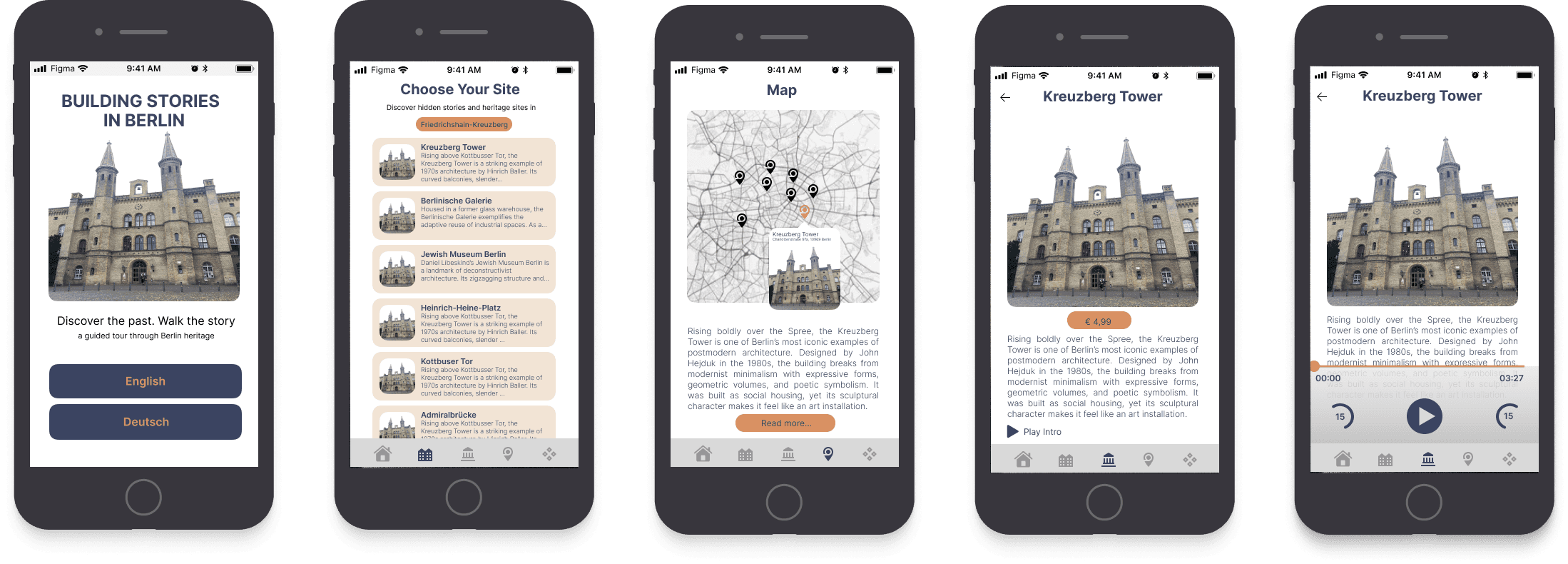
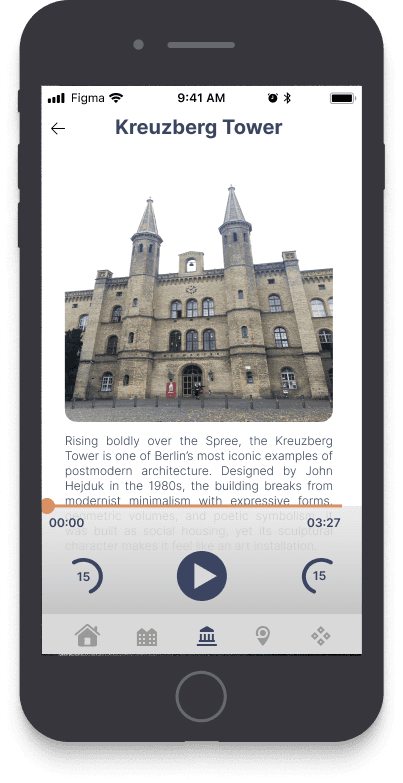
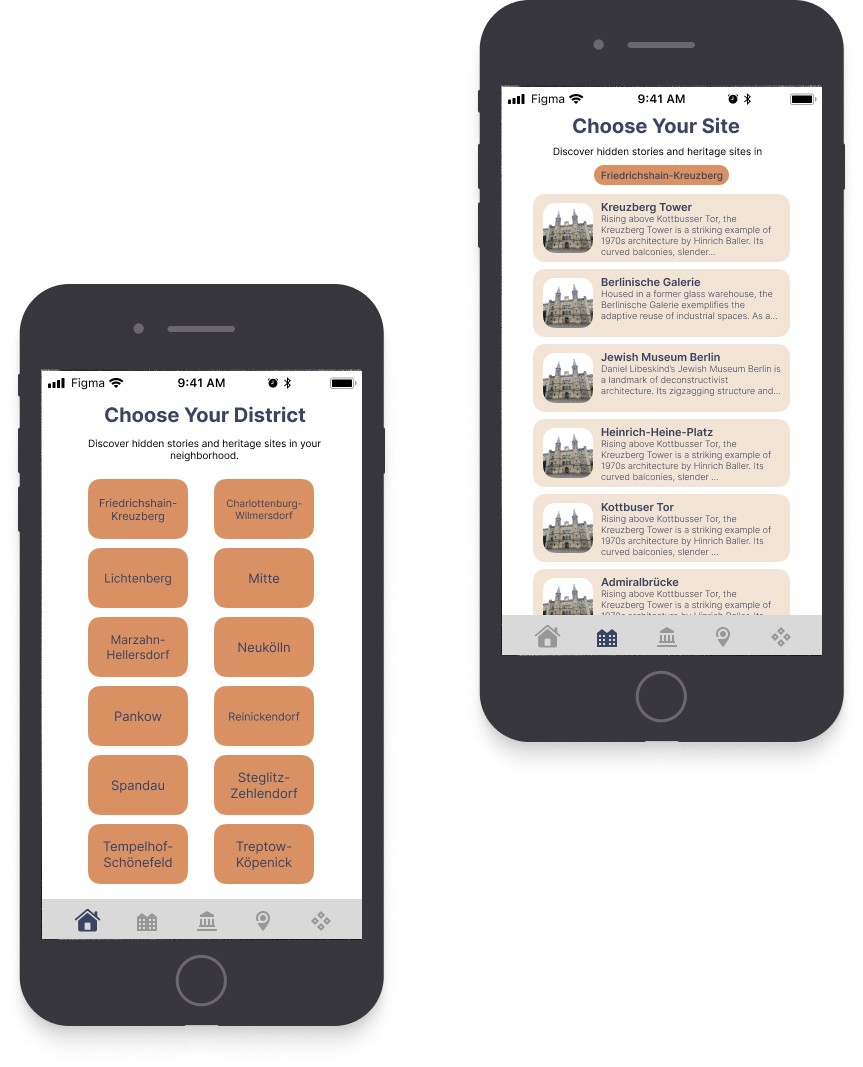
Design Brief:
With a background in architecture, photo editing, and heritage preservation, I’ve always been drawn to the emotional layers embedded in buildings—especially in cities like Berlin. During my time at the Ostkreuzschule and through work on cultural documentation projects, I saw how powerful local stories and visual narratives can be in shaping how people experience a place.
This inspired me to create a self-guided audio guide app that brings Berlin’s built heritage to life—starting with Kreuzberg, a district full of architectural diversity and cultural memory.
Design Brief:
With a background in architecture, photo editing, and heritage preservation, I’ve always been drawn to the emotional layers embedded in buildings—especially in cities like Berlin. During my time at the Ostkreuzschule and through work on cultural documentation projects, I saw how powerful local stories and visual narratives can be in shaping how people experience a place.
This inspired me to create a self-guided audio guide app that brings Berlin’s built heritage to life—starting with Kreuzberg, a district full of architectural diversity and cultural memory.
Challenge:
Berlin is rich in architectural heritage, yet many buildings and their stories remain overlooked. Existing tour apps often deliver generic, fact-heavy content with little emotional resonance or visual appeal. For architecture lovers, culturally curious locals, and off-the-beaten-path tourists, there is a clear gap:
→ No engaging, design-forward, story-based app that brings buildings to life through local voices.
User Group:
Berliners curious about the architectural history of their neighborhoods
Tourists looking for off-the-beaten-path stories and built heritage
Architecture & heritage lovers interested in details beyond dates and names
Cultural institutions & museums aiming to promote architectural heritage
People with limited time/mobility, seeking flexible exploration formats
User Group:
Berliners curious about the architectural history of their neighborhoods
Tourists looking for off-the-beaten-path stories and built heritage
Architecture & heritage lovers interested in details beyond dates and names
Cultural institutions & museums aiming to promote architectural heritage
People with limited time/mobility, seeking flexible exploration formats
Solution:
A self-guided audio guide app that combines narrative storytelling, photography, and modern UX design to make architecture feel personal, emotional, and accessible—starting with Berlin’s vibrant district of Kreuzberg. Users can explore architecture at their own pace, guided by emotionally rich stories, local voices, and curated visuals—turning everyday walks into meaningful experiences.
Solution:
A self-guided audio guide app that combines narrative storytelling, photography, and modern UX design to make architecture feel personal, emotional, and accessible—starting with Berlin’s vibrant district of Kreuzberg. Users can explore architecture at their own pace, guided by emotionally rich stories, local voices, and curated visuals—turning everyday walks into meaningful experiences.
Why It Stands Out:
Emotionally driven design: Heritage is not just history—it’s personal memory.
Inclusive by design: Audio + transcripts, legible type, color contrast.
Co-created content: With local artists, historians, and communities.
Hybrid format: Audio meets photography meets interactive maps.
UX Focus Areas:
Smooth onboarding for quick and intuitive access to tours
Mood- and theme-based discovery, not just location-based
GPS-triggered audio for immersive urban walks
Offline usability, especially for tourists and locals on the go
Competitive Analysis:
Competitive Analysis:
Feature | Building Stories In Berlin | VoiceMap | izi.TRAVEL |
|---|---|---|---|
Emotional Storytelling | ● High (local voices) | ● Moderate | ○ Minimal |
Modern UI / UX | ● Clean & intuitive | ● Polished | ○ Outdated |
Accessibility | ● Prioritized | ○ Limited | ○ Not specified |
Multilingual (DE / EN / EST) | ● Yes | ● Partial | ● Extensive |
Free to Use | ● Yes | ○ Partially paid | ● Yes |
Design Process:
Why It Stands Out:
Emotionally driven design: Heritage is not just history—it’s personal memory.
Inclusive by design: Audio + transcripts, legible type, color contrast.
Co-created content: With local artists, historians, and communities.
Hybrid format: Audio meets photography meets interactive maps.
I noticed a clear gap in existing heritage apps: they often feel impersonal, outdated, and visually uninviting
Conducted competitive analysis (izi.TRAVEL, VoiceMap)
Defined core user groups: locals, tourists, architecture lovers
I translated these findings into a clear problem statement and set user-centered design goals
I noticed a clear gap in existing heritage apps: they often feel impersonal, outdated, and visually uninviting
Conducted competitive analysis (izi.TRAVEL, VoiceMap)
Defined core user groups: locals, tourists, architecture lovers
I translated these findings into a clear problem statement and set user-centered design goals
Week 1 - Research & Problem Definition
Week 1 - Research & Problem Definition
Week 2 - User Insights & Journey Mapping
Week 2 - User Insights & Journey Mapping
Developed 2–3 key user personas (e.g. curious local, design-savvy tourist)
Mapped current user journeys with common pain points (impersonal tone, poor navigation)
Identified opportunities for improvement: emotional storytelling, modern UI, accessibility
Developed 2–3 key user personas (e.g. curious local, design-savvy tourist)
Mapped current user journeys with common pain points (impersonal tone, poor navigation)
Identified opportunities for improvement: emotional storytelling, modern UI, accessibility
Week 3 - Ideation & Wireframes
Week 3 - Ideation & Wireframes
Brainstormed key features: GPS-triggered audio, theme filters, offline access, multilingual support
Sketched user flows and low-fidelity wireframes for onboarding, map view, and audio player
Prioritized minimal, intuitive navigation with visual storytelling elements
Brainstormed key features: GPS-triggered audio, theme filters, offline access, multilingual support
Sketched user flows and low-fidelity wireframes for onboarding, map view, and audio player
Prioritized minimal, intuitive navigation with visual storytelling elements
Built a clickable prototype in Figma covering core screens
Integrated placeholders for photos, maps, and audio controls
Conducted informal user testing for usability and emotional tone
Collected feedback and noted changes for the next iteration
Built a clickable prototype in Figma covering core screens
Integrated placeholders for photos, maps, and audio controls
Conducted informal user testing for usability and emotional tone
Collected feedback and noted changes for the next iteration
Week 4 – Low-Fidelity Prototyping & Testing
Week 4 – Low-Fidelity Prototyping & Testing
This is an ongoing concept. Next steps include testing in Kreuzberg, expanding to other Berlin neighborhoods, and integrating community-generated stories. I'm currently looking for collaboration opportunities with cultural institutions or UX teams working on heritage-focused products
Design Process:
UX/UI Designer
UX Researcher
Role
Discovery
Ideation
Design
Research
Reflection
Process
Figma
Framer
Tools
I noticed a clear gap in existing heritage apps: they often feel impersonal, outdated, and visually uninviting
Conducted competitive analysis (izi.TRAVEL, VoiceMap)
Defined core user groups: locals, tourists, architecture lovers
I translated these findings into a clear problem statement and set user-centered design goals
Week 1 - Research & Problem Definition
Week 4 – Low-Fidelity Prototyping & Testing
Week 2 - User Insights & Journey Mapping
Developed 2–3 key user personas (e.g. curious local, design-savvy tourist)
Mapped current user journeys with common pain points (impersonal tone, poor navigation)
Identified opportunities for improvement: emotional storytelling, modern UI, accessibility
Week 3 - Ideation & Wireframes
Brainstormed key features: GPS-triggered audio, theme filters, offline access, multilingual support
Sketched user flows and low-fidelity wireframes for onboarding, map view, and audio player
Prioritized minimal, intuitive navigation with visual storytelling elements
Built a clickable prototype in Figma covering core screens
Integrated placeholders for photos, maps, and audio controls
Conducted informal user testing for usability and emotional tone
Collected feedback and noted changes for the next iteration
UX Focus Areas:
Smooth onboarding for quick and intuitive access to tours
Mood- and theme-based discovery, not just location-based
GPS-triggered audio for immersive urban walks
Offline usability, especially for tourists and locals on the go